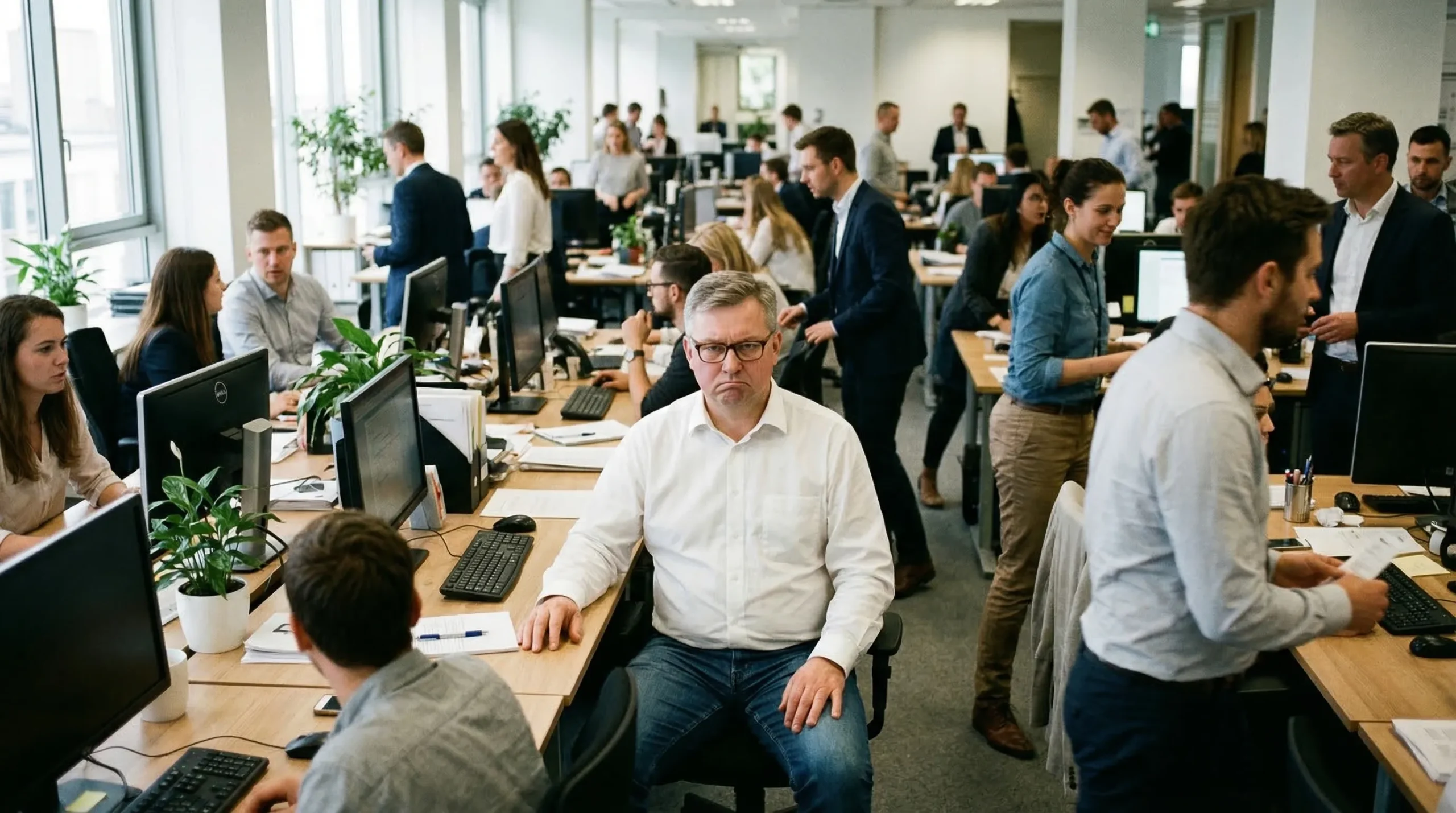
While “open office” is considered a cool innovation that emerged in Silicon Valley in the early 2000s, the concept actually goes back a bit further and is rooted in a romanticized ideology.
World War II necessitated changes in many aspects of the world.
One of these was changing Germany’s rigid, gray and hierarchically constrained corporate structures.
In the 1950s, brothers Eberhard and Wolfgang Schnelle laid the groundwork for a transformation in office use by initiating the “Bürolandschaft” movement.
These two brothers envisioned the workspace as a landscape, arranging desks within the office in a seemingly random, organic way, much like a garden, yet allowing for a flow of activity.
The aim was simple: to break down closed doors which had become status symbols, and to make everyone working in the same place part of the same ecosystem.
In this way, information would flow without being hindered by doors or bureaucracy and the workspace would become a more democratic place.
By the 1960s, Robert Propst had developed the concept of the “action office” to give employees more freedom of movement.
The action office approach which divided workspaces into individual cubicles, offered employees privacy and freedom of movement, while companies saw it as a way to fit people into boxes and save space.
Time passed, and by the 90s, we were talking about a completely different dynamic.
Companies that people started in their garages began to come to the forefront and jobs that were predominantly computer-based and software-related rose in popularity.
How did the startup spirit transform offices?
The most important reason for the proliferation of technology companies and the rise of technology-related jobs is undoubtedly the internet.
And companies that started in a garage yesterday and have become giants today didn’t want to lose their initial startup spirit.
Open offices without any walls began to transform into a playground where hierarchy ended, creativity burst forth from every corner and everyone could experience a Eureka! moment at any time.
On the other hand, the open office model became a way for corporate giants to say, We’re young, we’re fast too.
Even if they weren’t.
But there was a very important detail that huge companies overlooked in the change in office organization;
That a team of 5 people in a garage and a corporate department of 500 people do not have the same dynamics.
Why do open-plan offices seem more advantageous?
Office structures which transformed into something completely different in the 1950s with the motto of free flow of information, turned into a gigantic vortex in the 2000s where everyone was watching each other and no one could focus on their work due to the chaotic noise.
It would be wrong to attribute the adoption and widespread use of open-plan offices by many companies solely to their work strategies.
These workspaces were associated with being modern and dynamic and wrapped in a shiny packaging like a human-centered corporate approach.
The biggest promise of open-plan offices was to spread conversations held around the water dispenser throughout the entire office; that is, the theory of the clash of ideas; senepity; accidental creativity.
In other words, with the walls gone, a software developer and a marketer would come together and find that brilliant idea that no one had thought of before.
The issue is actually about removing the barriers to communication.
Information would be transferred organically and fluidly, without getting bogged down in the classic, tedious and slow approval mechanisms of a hierarchy; and the office would transform from a place where people came simply to do business into an incubator.

Breaking down doors and dismantling corner offices
It’s a fact that the closed doors, even double-sided corner offices, in classic offices give users a kind of power while creating distance between them and other employees. Open-plan offices are said to demolish these fortresses.
Having everyone working in the same environment, even at the same desk, with the CEO running the company sends the message that what matters in the company is the job, not the title.
This sense of equality and accessibility would increase employee loyalty to the company, make management more approachable, and make people in managerial positions more humane.
As psychological distance decreases, team spirit would skyrocket.
Now let’s look at the emotional side of things, the economic aspect.
Real estate prices and rents are now astronomical in large cities, rentals are now based on cubic meters.
This is what makes open-plan offices a lifeline for finance departments.
While corridors, doors, and even walls in traditional offices represent dead space, thanks to open-plan layouts, every square meter within the office can be planned and used as an active workspace.
This wasn’t just about saving money and optimizing for increased agility; it was about fitting more talented people into a smaller space.
The calculation was simple; thanks to the flexible office layout, as teams grew, they could simply add new desks without having to break down office walls.
Open-plan offices as a PR material
Good PR manages to sell even the worst thing as if it were the best. Open-plan offices are no exception.
Colorful armchairs and high-quality wooden desks scattered among modern-looking concrete walls and under industrial ceilings are quite effective in making those working there believe they are building the future.
This design concept is still successfully used today to attract millennials and Gen Z, turning the employer into a brand.
The office is thus transformed from a boring prison into a constantly living, engaging, and attention-grabbing experiential space.
This design and open-plan office concept of course serves the employer’s need for quick results and cost reduction rather than directly addressing the employee’s psychological needs.
Because the promise of increased internal office communication often serves as a silken veil covering the reality of easier control.

How do open-plan offices affect employees?
The promise of transparency in open-plan offices is only on paper; they are now at the very heart of cognitive invasion. Because as the walls come down, instead of feeling free people begin to don invisible armor.
The human brain needs to be free from external stimuli to enter deep work mode. This isn’t a whim, it’s part of the norm.
The problem with open-plan offices is that a phone call at the next desk, gossip going on somewhere in the back, loud music, or the visual movement of someone entering the office uninvited gradually distracts the brain from the attention it needs to work.
The brain can need up to 23 minutes to refocus after a simple distraction.
When you work in an open-plan office, you’re not actually working; you’re constantly trying to regain your scattered attention.

Open-plan offices, the feeling of “being monitored” and watched
Another effect of open offices on employees is the constant feeling of being watched, which psychologically undermines their sense of security.
If there is no real privacy in a place, employees begin to appear to be working rather than actually finishing the task at hand, a phenomenon known as performance theater.
Sitting with your back to a screen overlooking a corridor where people are sitting behind you or constantly passing by creates social anxiety which becomes increasingly chronic.
This situation is also related to the erosion of creativity in the long term; because being creative is directly linked to having the freedom to make mistakes and being comfortable.
Where have we ended up? Open offices were supposed to increase communication between units and employees, weren’t they?
The situation has reversed itself.
In an environment where everyone can hear everything, people hesitate to discuss in-depth topics.
Therefore, more and more people are seen hiding behind large headphones, sending the message don’t touch me.
In short, physical walls have been replaced by seemingly insurmountable digital and psychological walls.
Open-plan offices not only tire the mind and soul, but also the body.
Uncontrolled noise levels keep cortisol known as the stress hormone, constantly on high alert.
A Harvard Business School study is like the finishing touch on all the beauties of the open-plan office concept:
When companies tore down the walls of offices, face-to-face interaction decreased dramatically.
People took refuge in email and instant messaging applications to protect themselves from this excessive one-on-one socialization.
So, even when sitting side-by-side, instead of opening their mouths and exchanging a few words about the topic, two people started sending each other messages.
Sharing the same physical space doesn’t mean being on the same wavelength; perhaps this is the biggest illusion created by open-plan offices.

The transformation of open-plan offices
At this point, it’s clear that the productivity promised by open offices is a huge illusion.
However, dividing the office with walls again isn’t the ultimate solution either.
In the modern world, the concept of the office is also changing, and providing everyone with a uniform office is outdated. Instead, a transformation into an ecosystem called Activity-Based Working (ABW), where the office can be personalized according to needs, is being adopted.
On the other hand, while open office designs aren’t completely abandoned, the balance between “me” and “us” is being given more consideration and offices are ceasing to be huge empty spaces and are being supported by various modes.
For example:
- Cells free from all noise and distractions for deep focus.
- Energetic hubs where noise is free and socialization is possible for real brainstorming.
- Technology-free green zones designed to relieve cognitive fatigue, have a coffee or eat a piece of chocolate.
Giving an employee the freedom to choose where and how they work is more effective than giving them the most expensive and ergonomic chair and making them sit in an open office all day.
The successful companies of recent years no longer confine their employees to a desk; they provide them with spatial mobility according to the nature of their work.
Tearing down walls is like a sledgehammer blow, but building the mental spaces and ability to focus that those walls protect is a matter of culture.
Perhaps what we need to talk about now is not just office architecture but office etiquette.
…
People want to be part of a community and say “we,” and they also want to withdraw into themselves and be “I” when necessary.
The success of the modern office concept depends on its ability to accommodate these two opposing poles under the same roof, without crushing each other and simultaneously.
We’ve torn down the walls, that’s fine; now it’s time to succeed in rebuilding the invisible but much more durable boundaries that protect our souls and minds, through mutual respect and proper design.
References and further reading